
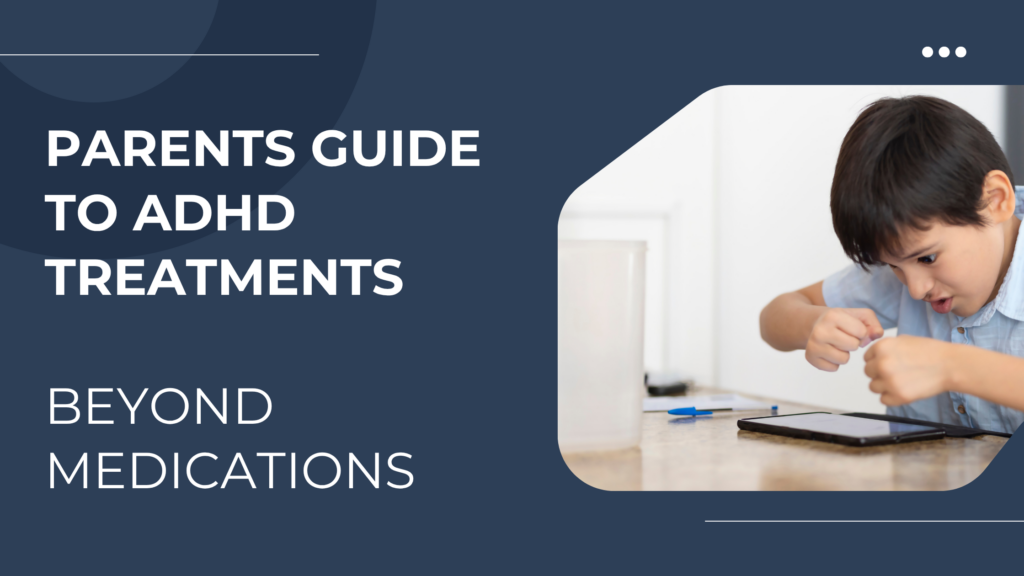
Six O’Clock, Every Evening
The worksheet has four questions on it. Four. You have been at this table for ninety minutes.
Your child has sharpened a pencil twice, gone to the bathroom three times, asked about dinner, cried once, and written their name at the top. The paper is still mostly white.
You have tried being patient. You have tried being firm. You have tried the timer, the sticker chart, the reward, the threat, and the deep breath you took in the hallway so nobody would see your face.
And somewhere in the middle of it, a thought arrives that you never say out loud: I am doing this wrong, and I do not know what the right way looks like.
If that evening sounds familiar, take one thing with you before we go further. Homework battles with an ADHD child are not proof of bad parenting. They are proof that a standard task is being handed to a nonstandard brain, and neither of you was given instructions.
This blog is about what comes next. Specifically, it is about the options that exist alongside or instead of medication, what each one actually involves, what the evidence generally looks like, and how to judge which ones deserve your time and money.
It is written plainly, because you are already tired.
One thing to say clearly at the start: this is general information, not medical advice for your child. Decisions about diagnosis and treatment belong with qualified professionals who have actually assessed your child. What follows is meant to help you have better conversations with them, not to replace those conversations.
First, What Is Actually Happening
ADHD is often described as a problem of not paying attention. That description fails most families, because they have all watched their child focus intensely on something for three hours straight.
A more useful way to think about it is difficulty with regulation. Not the absence of attention, but trouble directing it on purpose, especially toward things that feel boring, delayed, or unrewarding.
This is why the same child can build in a game world for an entire afternoon and cannot begin four maths questions. The game gives constant feedback, immediate reward, and clear next steps. The worksheet gives none of those things.
Several everyday abilities tend to be affected.
Starting. Beginning a task can feel almost physically difficult, even when the child wants to do it.
Staying. Attention wanders, especially without new input.
Stopping. Moving away from something interesting is genuinely hard.
Waiting. Delay feels heavier than it does for other children.
Ordering. Knowing what to do first, second, and third does not come naturally.
Estimating time. Ten minutes and an hour can feel roughly the same.
Holding information. Instructions disappear halfway through the walk to the other room.
Managing feeling. Frustration arrives fast and large.
Once you see homework through this lens, the battle makes more sense. Homework requires almost every one of those abilities at once, at the end of a day when the child has already spent everything they had holding it together at school.
Why Families Look Beyond Medication
Medication is one of the most studied approaches for ADHD, and for many children it helps meaningfully. Nothing here argues against it.
But families explore other paths for many reasons, and all of them are legitimate.
Some children respond poorly or experience side effects. Some are too young for their doctor’s comfort. Some families want to try other approaches first. Some are already using medication and find it helps attention while leaving organisation, emotions, and homework routines untouched. Some are managing cost or access. Some children simply refuse.
There is also an important truth that gets lost in arguments about medication. Even when medicine works well, it does not teach skills. A child may become more able to sit and listen, and still not know how to break a project into steps or start something boring.
That gap is where most of the approaches below live.
The Honest Frame for Judging Options
Before the list, here is the filter to hold in your mind, because you will be marketed to.
Some approaches have strong research behind them. They are widely recommended and studied.
Some have moderate or mixed research. They may help some children in some ways, and the evidence is still being debated.
Some have weak evidence but low risk. Sleep and exercise fall here in the sense that they are good for children generally, even where the specific effect on ADHD symptoms is modest.
Some have weak evidence and high cost. This is where families lose money and time.
You do not need to memorise which category each thing falls into. You need to ask one question of every provider: what evidence supports this for a child like mine, and what would improvement look like?
Vague answers to that question tell you what you need to know.
Behaviour Focused Parent Training
This one surprises people, because it does not sound like treatment. It is, however, among the most consistently recommended non medication approaches for younger children, and it is usually the first thing specialists suggest.
The name is unfortunate. It sounds like being told you are the problem. It is not that.
What it actually involves is being taught a specific set of tools for a specific kind of brain. How to give instructions that survive the walk down the hallway. How to build reward systems that work for a child who cannot feel a reward that arrives on Friday. How to reduce power struggles. How to respond to emotional storms without escalating them. How to structure transitions, which are usually where the explosions happen.
Parents who go through it often report that the largest change is not in the child. It is in the temperature of the house.
Best suited for younger children and families locked in daily conflict.
Realistic expectations. Behaviour usually improves at home before it improves at school. Consistency matters more than perfection.
Watch for programs that blame parents rather than equip them, and programs run by people with no real training in child behaviour.
School Support and Accommodations
This is the option families most often underuse, and it costs nothing.
Schools can adjust how work is given and assessed. Depending on the country and system, this may come through a formal plan or informal arrangements with teachers. Either way, the goal is the same: reduce the parts of school that punish an ADHD brain for being an ADHD brain.
Common adjustments include seating away from distraction, extra time, breaking long assignments into smaller submissions, written instructions rather than spoken ones, permission to move, reduced homework volume where appropriate, and a check that homework was actually recorded before the child leaves.
That last one alone ends a surprising number of evening arguments.
Best suited for every school aged child with ADHD, alongside anything else you do.
Realistic expectations. Implementation depends heavily on individual teachers. Relationships matter.
Watch for plans that exist on paper and never in the classroom. Follow up is part of the work.
Skills Coaching for Older Children and Teens
Younger children need the environment changed around them. Older children need to start building their own systems, and they usually need someone other than a parent to teach them.
Coaching focuses on practical function. Planning. Breaking work into steps. Estimating how long something takes. Managing phones and devices. Starting difficult tasks. Preparing for exams without an all night collapse.
The reason an outside person often works better than a parent is simple. With a parent, every suggestion carries years of history and emotion. With a coach, it is just a method.
Best suited for teenagers, particularly around transitions to harder school stages.
Realistic expectations. Teens must be at least somewhat willing. Forced coaching rarely holds.
Watch for wide variation in coach training. Ask what qualifications they hold and who trained them.
Therapy for the Weight Around ADHD
ADHD rarely travels alone in older children. Years of being corrected, compared, and told to try harder leave marks.
Many children develop anxiety about school, a belief that they are stupid, or a habit of avoiding anything they might fail at. Some develop low mood. Some become explosive because that is easier than admitting they feel lost.
Therapy does not treat the attention difficulty directly. It treats what has grown around it, which can be just as disabling.
Best suited for children showing anxiety, low self worth, avoidance, or emotional volatility.
Realistic expectations. This is slower work and worth it.
Watch for therapists unfamiliar with ADHD, who may misread the behaviour entirely.
Sleep, Which Nobody Wants to Hear About
This section gets skipped, so please do not skip it.
Sleep problems and attention problems feed each other in a loop. Poor sleep worsens focus, emotional control, and frustration tolerance. ADHD makes settling at night harder. Round and round it goes.
Sometimes a substantial portion of what looks like worsening symptoms is simply a child who has been running on insufficient sleep for months.
It is also worth knowing that some medical sleep conditions can cause daytime symptoms that resemble attention difficulties. If your child snores heavily, gasps, or seems to stop breathing during sleep, mention it to a doctor. That is a medical question, not a routine question.
Best suited for essentially every family, before spending money elsewhere.
Realistic expectations. Changes take weeks to show, not days.
Watch for treating a possible medical sleep issue as a discipline issue.
Movement and Physical Activity
Exercise is not a treatment for ADHD, and anyone selling it as one is overreaching. But it is genuinely useful as support.
Movement often helps mood, sleep, and the ability to settle afterwards. Many children focus better on schoolwork after physical activity than before it. Activities that involve learning sequences, coordination, and rules may offer more than repetitive movement alone.
The practical trick is placement. Movement before homework often works better than movement after, though families differ.
Best suited for almost everyone, as support rather than solution.
Realistic expectations. Helpful, not transformative.
Watch for programs charging heavily for what a park and a ball provide.
Food and Supplements
This area generates strong opinions and a lot of selling.
The honest summary is that dietary approaches for ADHD have been studied and results are mixed, with effects generally smaller than families hope. A small number of children may react to specific foods, but identifying that requires careful, structured testing rather than guesswork.
Basic nutrition still matters. A child who skipped breakfast and ran on sugar until three in the afternoon will struggle regardless of anything else.
Two cautions. First, restrictive diets carry real costs for children, socially and nutritionally, and should not be started casually. Second, supplements are not automatically safe simply because they are sold without prescription. Some interact with medications.
Best suited for basic nutritional stability in every child.
Realistic expectations. Modest at best for symptoms.
Watch for expensive supplement packages, testing that promises to reveal hidden causes, and anyone telling you to stop prescribed medication.
Neurofeedback and Brain Training Programs
You will encounter these, so it is worth understanding what they claim and what the debate is.
Neurofeedback involves measuring brain activity and giving the child feedback, often through a game or visual display, with the aim of training patterns associated with attention. Computerised brain training uses repeated exercises to build working memory or attention.
Research in this area exists, and it is genuinely contested. Supporters point to studies showing benefit. Critics point out that many studies were small, that improvements sometimes came from parent reports rather than blinded measures, and that gains often appear within the training tasks without clearly transferring to school and home.
That does not mean nobody benefits. It means the evidence is not settled, the cost is often substantial, and the commitment is long.
If you are considering it, ask directly. How many sessions before we should expect anything? What exactly will be measured, and by whom? Will improvement be judged by anything other than my own impression? What happens if there is no change?
Best suited for families who have addressed the basics, understand the debate, and can afford it without strain.
Realistic expectations. Uncertain. Approach with open eyes rather than hope alone.
Watch for confident cure language, results shown only as testimonials, and long contracts pushed at the first visit.
Approaches Requiring Extra Caution
Some offerings in this space have little supporting evidence and significant cost. Be careful with anything that promises to eliminate ADHD, that requires very long prepaid commitments, that discourages medical involvement, or that relies on unusual tests to find causes other professionals supposedly missed.
A useful rule: the more a provider criticises doctors, the more carefully you should read the contract.
Table 1: Comparing the Main Non Medication Directions
| Approach | What It Involves | Best Suited For | Time Commitment | Key Question to Ask |
|---|---|---|---|---|
| Parent behaviour training | Structured teaching of behaviour and routine strategies | Younger children, high conflict homes | Weekly sessions across several weeks | Who developed this program and what training do you have? |
| School accommodations | Adjustments to how work is given and assessed | All school aged children | Meetings plus ongoing follow up | How will we check this is actually happening in class? |
| Skills coaching | Practical planning, starting, and organisation systems | Teens and older children | Weekly or fortnightly | What qualifications do coaches here hold? |
| Therapy | Work on anxiety, self esteem, avoidance, emotion | Children carrying emotional weight | Weekly, longer term | How much experience do you have with ADHD? |
| Sleep improvement | Routine changes, screen limits, medical screening | Nearly every family | Several weeks to see change | Should we rule out a medical sleep problem first? |
| Physical activity | Regular movement, ideally skill based | Nearly every child | Most days | Is this priced fairly for what it is? |
| Diet and nutrition | Stable eating patterns, structured testing if indicated | Children with poor nutritional basics | Ongoing | Is any restriction supervised by a qualified professional? |
| Neurofeedback and brain training | Measured sessions aiming to train attention patterns | Families who have covered basics and understand the debate | Often many sessions over months | What will be measured objectively, and when? |
The Homework Table Itself
Whatever larger path you choose, the evening still arrives. So here is the practical part.
Understand first that after school is the hardest window of the day. Your child has spent hours suppressing impulses, sitting still, and following instructions. Whatever regulation they had is gone. Asking for concentrated effort at that moment is asking for something that is genuinely not available yet.
A break before homework is not laziness. It is refuelling.
Shrink the task until it looks possible. A page of ten problems can feel impossible. Two problems does not. Cover the rest with paper if needed. Reveal work in pieces.
Work in short bursts. Many families find short focused stretches followed by real breaks work far better than long sessions. Adjust length to your actual child, not to advice.
Make starting the smallest possible act. Getting started is often the hardest part. Reduce the first step until it is almost silly. Write only your name. Read only the first line.
Use a visible finish line. Uncertainty about how long something will last is exhausting. A clock, a timer, or a checklist gives the brain something to aim at.
Allow movement. Standing, bouncing, fidgeting, or lying on the floor while working is not disrespect. For many children it supports concentration rather than harming it.
Remove the phone from the room. Not face down. Out.
Separate teaching from tension. If explaining a concept always becomes a fight, that concept probably needs a different teacher. Ask the school.
Set a stop time and honour it. Endless homework destroys evenings and teaches a child that effort has no end. Stop at a fixed time and write a short note to the teacher explaining what was completed. That note is not failure. It is data the school needs.
Notice effort more than output. The goal tonight is not perfect work. It is a child who does not conclude that they are stupid.
Table 2: Homework Struggles and Practical Responses
| What You See | What May Be Behind It | What Often Helps |
|---|---|---|
| Refuses to begin | Starting difficulty, task feels enormous | Make the first step tiny and start it together |
| Starts, then drifts within minutes | Attention fades without new input | Short bursts with real breaks between |
| Forgets what to do | Instructions did not stick | Written steps, one visible at a time |
| Explodes at small errors | Frustration arrives fast and big | Pause, move, return, no lecture during the storm |
| Takes hours for short work | Time estimation and drift combined | Fixed stop time plus a note to the teacher |
| Loses everything | Organisation, not carelessness | One folder, one place, checked at the same time daily |
| Works well then collapses | Depleted after holding it together at school | Break and food before starting |
| Claims there is no homework | May be genuine, may be avoidance | Confirm through the school, without accusation |
| Fine alone, fights with you | The relationship is carrying the tension | Change who teaches, not how loudly |
| Perfectionist paralysis | Fear of being wrong | Permission to submit imperfect work |
What to Say When It Has Gone Badly
Some evenings will end badly no matter what you do. The repair afterwards matters more than the incident.
Say plainly that the homework got hard and both of you got frustrated. Say that the difficulty is with the work, not with them. Say that tomorrow you will try a different way. Then let it go.
Children with ADHD hear a very high volume of correction across a day. Home should not simply add to that total. Some of what you are protecting is not tonight’s worksheet. It is the belief, ten years from now, that they are capable of things.
Looking After the Adult in the Room
Nobody puts this in guides, so it goes here.
Parenting a child with ADHD is genuinely harder work. More supervision. More conflict. More logistics. More emails from school. More decisions and less rest.
You are allowed to find it exhausting without that meaning you love your child less.
Practical things help. Share the homework role with another adult where possible, so the same person is not always the enforcer. Talk to other parents in the same situation, because their advice is more useful than advice from parents whose children simply do their homework. Lower standards on things that do not matter to protect energy for things that do. And consider your own support if the strain is affecting your health.
A depleted parent cannot deliver any of the strategies above. Your capacity is part of the treatment plan whether anyone says so or not.
Building Your Actual Plan
Rather than choosing one approach, most families do better assembling a few layers.
Start with foundations. Sleep, food, movement, and a homework setup that does not fight the child’s brain. These are free, low risk, and often more impactful than families expect.
Add structure next. School accommodations and behaviour strategies at home. These shape the environment so the child is not asked to overcome it alone every single day.
Add skills after that. Coaching or organisational teaching, particularly for older children who need to build systems they can carry forward.
Add emotional support wherever it is needed, and often it is needed.
Consider additional interventions last, once the basics are genuinely in place, with clear questions and clear measures.
And keep medication decisions where they belong, in conversation with your child’s doctor, informed by how your child is actually doing rather than by anyone’s opinion online.
Give any change six to eight weeks before judging it, and change one significant thing at a time. If you change five things at once and something improves, you will never know what to keep.
The Part Worth Remembering
You are not managing a discipline problem. You are helping a developing brain that struggles with starting, ordering, waiting, and holding on, in a system that assumes those abilities are automatic.
That reframe changes almost everything. It turns a nightly fight into a design problem, and design problems have solutions.
Some of those solutions are free and available tonight. Some require professionals. Some will work beautifully for your child and do nothing for the child down the street, which is why other people’s confident advice often misses.
Go slowly. Test one thing at a time. Ask hard questions of anyone taking your money. Keep your child’s doctor in the conversation.
And on the evenings when it all falls apart anyway, remember that the worksheet was never the point. The child who still believes they can learn is the point, and protecting that belief is the most useful thing happening at that table.