

Gratitude is often misunderstood.
Many people hear the word gratitude and think it means ignoring pain, pretending everything is fine, or forcing a positive attitude. But real gratitude is not denial. It is attention training.
Gratitude helps the brain notice what is present, supportive, meaningful, or steady. It gives the mind something specific and real to hold onto, especially when stress, fear, or negativity are taking up too much space.
At Brain Performance Center, we often talk about the brain’s tendency to focus on threat. This is not a flaw. It is part of survival. The brain is designed to notice danger, remember pain, and predict what might go wrong. But when the threat system becomes too dominant, the brain may begin to overlook what is working, what is safe, and what is still possible.
Gratitude is one way to interrupt that pattern.
Gratitude Is Not Toxic Positivity
Toxic positivity says, “Just look on the bright side.” Gratitude says, “Let me also notice what is still true, steady, or meaningful.”
There is a big difference.
A person can be grieving and grateful. A person can be stressed and grateful. A person can be disappointed and grateful. A person can be healing and grateful.
Gratitude does not erase the hard thing. It widens the frame. It reminds the brain that the hard thing is not the only thing.
This matters because the brain under stress can become narrow. It may focus only on the problem, only on the fear, only on the mistake, only on the unknown. That narrow focus can increase anxiety, rumination, and emotional reactivity.
Gratitude gives the brain another direction to look.
What Research Says About Gratitude
Research on gratitude interventions suggests that gratitude practices can improve feelings of gratitude, support mental health, and improve well-being, though results vary depending on the person and the type of practice. A systematic review and meta-analysis found that gratitude interventions were associated with better mental health and fewer symptoms of anxiety and depression.
Another systematic review focused on workers found that gratitude interventions may support mental health and well-being in workplace settings.
This does not mean gratitude is a cure-all. It is not a replacement for therapy, medication, neurofeedback, sleep, nutrition, or medical care. But it can be a simple and accessible tool that supports mental flexibility and emotional regulation.
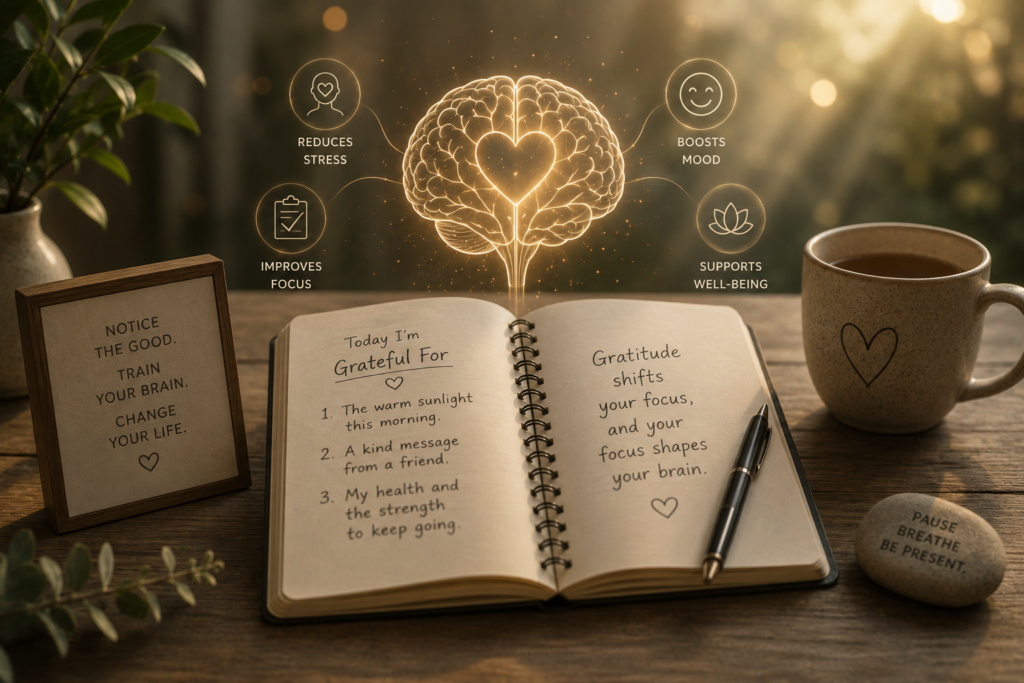
Why Gratitude Helps the Brain
The brain strengthens what it repeatedly practices. If the brain repeatedly practices scanning for threat, it becomes more efficient at finding threat. If it repeatedly practices self-criticism, it becomes more efficient at self-criticism. If it repeatedly practices noticing support, connection, progress, and meaning, those pathways can become easier to access.
Gratitude helps train attention.
Instead of asking, “What is wrong?” the brain learns to also ask: What helped me today? What did I handle better than before? Who supported me? What felt peaceful, even briefly? What did my body do for me today? What is one thing I do not want to take for granted?
These questions matter because attention shapes experience. What the brain repeatedly attends to becomes more emotionally available.
Easy Gratitude Is Specific Gratitude
The most effective gratitude practice is usually not vague. It is specific.
Instead of “I am grateful for my health,” try “I am grateful my body had enough energy to walk outside today.”
Instead of “I am grateful for my family,” try “I am grateful my son called and told me about his day.”
Instead of “I am grateful for my job,” try “I am grateful I had one focused hour where I completed something important.”
Specific gratitude gives the brain a clearer memory. It creates an emotional snapshot. The more specific the gratitude, the easier it is for the brain to connect with it.
Five Easy Gratitude Practices
1. The One-Line Gratitude Practice
This is the simplest place to begin.
At the end of the day, write one sentence: “Today, I am grateful for __________ because __________.”
The “because” matters. It deepens the practice.
For example: “Today, I am grateful for the quiet drive home because it gave my brain time to settle.”
This takes less than one minute, but it trains reflection and emotional awareness.
2. The Nervous System Gratitude Practice
This practice focuses on safety and regulation.
Ask: Where did I feel even slightly safe today? When did my body relax, even briefly? Who or what helped my nervous system settle?
This is especially helpful for people who live with anxiety, trauma, chronic stress, or emotional overload. It teaches the brain to notice cues of safety.
Examples might include: “I felt safe when I sat outside with my coffee.” “My body relaxed when I took a deep breath before the meeting.” “I felt supported when my friend checked in.”
The goal is not to pretend the whole day felt safe. The goal is to notice the moments that did.
3. The Gratitude Reframe
This practice is useful when the brain is stuck in frustration.
Start with something difficult: “I am frustrated that the meeting was delayed.”
Then add a grounded gratitude statement: “I am grateful I had extra time to prepare my notes.”
This is not about denying frustration. It is about building cognitive flexibility. Two things can be true: the delay was frustrating, and something useful came from the extra time.
4. The Body Gratitude Practice
Many people relate to their bodies through criticism. They notice what hurts, what looks different, what feels weak, or what is not working.
Body gratitude shifts the relationship.
Ask: What did my body help me do today? What part of my body worked hard for me? What sensation reminded me I am alive and present?
Examples might include: “I am grateful for my legs carrying me through the day.” “I am grateful for my hands helping me work, cook, and connect.” “I am grateful my breath is always available as a reset.”
This can be especially meaningful for people recovering from stress, illness, injury, burnout, or trauma.
5. The Relational Gratitude Practice
Gratitude becomes even more powerful when it is expressed.
Send a short message: “I just wanted you to know I appreciated what you said today.” “Thank you for listening. It helped more than you know.” “I am grateful for the way you showed up for me.”
Relational gratitude strengthens connection. Connection is one of the most important protective factors for mental and brain health.
Gratitude and Negative Thinking
Negative thinking can become familiar. The brain may return to worry, self-criticism, or fear because those patterns are well rehearsed. Gratitude can help interrupt threat-focused attention by directing the brain toward grounded evidence of support, safety, meaning, or connection.
This is not the same as positive thinking. Positive thinking can sometimes become future-focused: “Everything will work out.” Gratitude is often present-focused: “This one thing is supporting me right now.”
That distinction matters. The anxious brain may not believe a broad positive statement. But it may be able to recognize something specific and real.
When Gratitude Feels Hard
Sometimes gratitude is difficult. If you are depressed, grieving, burned out, traumatized, or overwhelmed, gratitude may feel inaccessible or even irritating. That does not mean you are doing it wrong.
Start smaller.
Instead of asking, “What am I grateful for?” ask: What is one thing that made today slightly less hard? What is one thing I do not want to lose sight of? What helped me get through the last hour? What is one neutral thing I can appreciate?
Gratitude does not have to feel big. It only has to be honest.
A Seven-Day Easy Gratitude Challenge
Day 1
One thing that supported me today.
Day 2
One person I appreciate.
Day 3
One thing my body did for me.
Day 4
One moment of calm.
Day 5
One challenge that taught me something.
Day 6
One thing I usually take for granted.
Day 7
One thing I want to carry into tomorrow.
At the end of the week, read the list. Notice what your brain might have missed if you had not paused to record it.
Gratitude Is a Brain Habit
Gratitude is not a personality trait reserved for naturally optimistic people. It is a trainable brain habit.
The more you practice noticing what is supportive, meaningful, steady, or good, the easier it becomes for the brain to access those experiences. Over time, gratitude can become part of emotional regulation, attention training, and resilience.
You do not need a perfect life to practice gratitude. You need one honest moment of attention.
That is where the brain begins to shift.
Making Gratitude Practical
The most useful gratitude practice is the one you will actually repeat. For some people, that means writing one sentence before bed. For others, it means saying one thing out loud at dinner, sending a short thank-you text, or pausing during a stressful day to notice one thing that is still steady.
Do not make gratitude another performance standard. Keep it simple, specific, and honest. When gratitude becomes easy to practice, it becomes easier for the brain to access in moments of stress. That is when it becomes more than a habit. It becomes part of how you regulate.
Take the First Step Toward Better Brain Health
If stress, anxiety, negative thinking, or emotional overload are making it difficult to feel grounded, Brain Performance Center can help you explore brain-based tools for emotional regulation and resilience.
References
[1] Cregg, D. R., & Cheavens, J. S. Gratitude Interventions: Effective Self-Help? A Meta-Analysis of the Impact on Symptoms of Depression and Anxiety. . https://pmc.ncbi.nlm.nih.gov/articles/PMC10393216/
[2] Komase, Y., et al. Effects of Gratitude Intervention on Mental Health and Well-Being Among Workers: A Systematic Review. https://pmc.ncbi.nlm.nih.gov/articles/PMC8582291/