
You made it through school. Maybe barely, maybe with grades that never matched how hard you were trying, maybe by being smart enough to scrape through even when nothing stuck. You built a career. You have relationships. From the outside, things probably look mostly fine.
But inside, it has always felt like running a race where everyone else got a different set of legs. You sit down to work and twenty minutes later you have no idea where the time went. You start five things and finish none of them. You forget a conversation from yesterday but can quote a film you watched once in 2007. You say things before you have thought them through and then spend the next three days replaying it. You feel things more intensely than seems normal. You get overwhelmed by tasks that should be simple. You have been told your whole life that you just need to try harder, stay more organized, focus more, be more consistent.
You have been trying harder your entire life. That was never the problem.
The problem is that nobody looked closely enough at what was actually happening in your brain.
Adult ADHD that was never caught in childhood is one of the most under-recognized and undertreated conditions in mental health. For decades, ADHD was thought of as a childhood problem, something hyperactive boys had, something people grew out of. The adults who never fit that picture, who were not hyperactive but were deeply distracted, who were girls who internalized everything, who were smart enough to compensate until the demands of adult life exceeded their ability to cope, those people fell through the cracks.
If you are reading this and something in that first paragraph felt uncomfortably familiar, you are not alone. And more importantly, there are real, effective treatment options available right now. At The Brain Performance Center in Dallas, TX, we work with adults who were never diagnosed as kids and who are finally, sometimes in their thirties, forties, or fifties, getting answers and getting help.
Why So Many Adults With ADHD Were Never Diagnosed
Understanding why the diagnosis was missed is not just interesting background. It actually matters for treatment, because the patterns that developed around an undiagnosed ADHD brain are part of what needs to be addressed.
ADHD Looked Different Than Anyone Expected
The ADHD picture most people grew up with was a little boy bouncing off the walls, unable to sit still, disrupting class. That presentation is real, but it is only one version of a much broader condition.
Many adults with ADHD were not hyperactive in any obvious physical way. Their hyperactivity was internal. A mind that never stopped moving, that jumped between thoughts faster than they could catch them, that could not settle even when the body was sitting perfectly still. This internal restlessness is much harder to see from the outside, and teachers and parents often missed it entirely.
Girls with ADHD were particularly likely to go undiagnosed. Research has consistently shown that girls tend to present with more inattentive symptoms and less hyperactivity, are more likely to internalize their struggles rather than act out, and are more likely to develop coping strategies that mask the underlying difficulty. They got labeled as daydreamers, or sensitive, or anxious, or underachievers who just needed to apply themselves more.
Adults who were highly intelligent faced a different masking problem. Raw intelligence can compensate for ADHD for years. A bright kid can get by on minimal effort and still pass. They can absorb enough in class to perform without actually being able to sustain attention consistently. The compensation works until it does not, and for many people that breaking point comes in college, or in their first demanding job, or when they become parents and the organizational demands of life multiply overnight.
The Emotional Side Nobody Talked About
One of the most overlooked features of adult ADHD is emotional dysregulation. The ADHD brain does not just struggle with attention. It struggles with emotional intensity, with rejection sensitivity, with the speed and force of emotional reactions that seem disproportionate to what triggered them.
Adults with undiagnosed ADHD often spent their childhoods and early adult years being told they were too sensitive, too reactive, too dramatic. They developed deep shame around emotions they could not control. Many were diagnosed with anxiety or depression instead of ADHD, because those emotional symptoms were the most visible thing. The underlying attention and regulation problems continued unaddressed while the anxiety or depression got treated in isolation.
This matters because treatment for adult ADHD that was missed in childhood needs to address not just attention and focus but the emotional patterns, the shame, the compensatory behaviors, and the anxiety and depression that often developed alongside the ADHD over decades.
What Is Actually Happening in the ADHD Brain
Before talking about treatment, it helps to understand what ADHD actually is at the neurological level, because this is what makes brain-based treatment so relevant.
ADHD is not a problem of willpower or effort. It is a problem of brain regulation. Specifically, it involves differences in how the brain produces and uses certain brainwave patterns, how the prefrontal cortex manages attention and impulse control, and how neurotransmitter systems, particularly dopamine and norepinephrine, function in the circuits responsible for focus and motivation.
In many adults with ADHD, the brain shows an excess of slow-wave activity, particularly theta waves, in the frontal regions. These are the areas responsible for executive function, the management system of the brain that handles planning, prioritization, working memory, impulse control, and emotional regulation. When those areas are running too slow, everything they are supposed to manage becomes harder.
At the same time, the brain’s dopamine system works differently. The ADHD brain often needs a higher level of stimulation to feel engaged. This is why tasks that are novel, urgent, interesting, or emotionally charged can pull in full focus easily, while tasks that are routine, repetitive, or low-stakes produce almost complete inability to engage. It is not a choice. The brain’s reward circuitry is responding to the stimulation level of the task, and routine tasks simply do not provide enough signal to activate the focus system.
This neurological picture is important because it tells us where effective treatment needs to reach. Telling someone with ADHD to just focus harder is like telling someone with a broken leg to just walk faster. The tool needed is one that actually addresses the brain’s patterns, not just the behavior on the surface.
What Treatment Options Are Available for Adults With ADHD Now
At The Brain Performance Center in Dallas, TX, we approach adult ADHD treatment as a brain-based challenge that requires brain-based tools. Here is what that looks like in practice:
Neurofeedback for Adult ADHD
Neurofeedback is one of the most direct and well-researched non-medication treatments for ADHD. It works by training the brain’s electrical patterns in real time, directly targeting the neurological differences that drive ADHD symptoms.
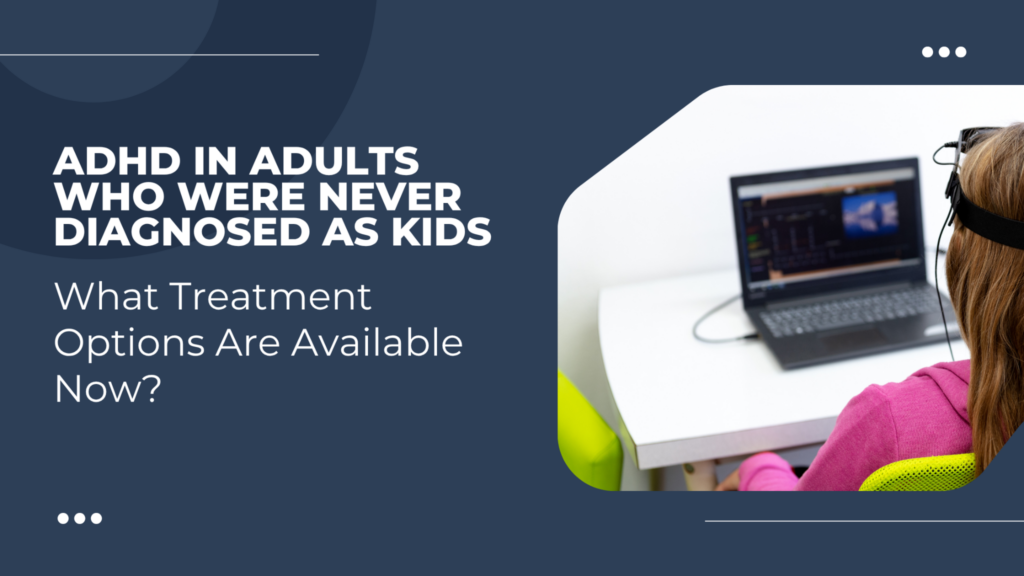
During a neurofeedback session, sensors are placed on the scalp to read the brain’s electrical activity. That activity is displayed in the form of a game or a visual on a screen. When the brain produces the patterns associated with focus and calm regulation, the display rewards it. When the brain drifts into the slow, scattered patterns associated with ADHD, the display pauses or dims.
Over many sessions, the brain learns. The pathways associated with focused, regulated attention get stronger through repeated activation. The excessive slow-wave patterns that have been dominating the frontal regions start to thin out. The brain becomes more capable of sustaining the kind of attention that ADHD has always made difficult.
For adults who were never diagnosed as kids, neurofeedback addresses the underlying brain pattern that has been causing problems for decades. The sessions are passive, meaning no effort or concentration is required. The brain does the work automatically in response to the feedback signal.
We also offer whole-brain neurofeedback, which targets not just individual regions but the networks connecting different parts of the brain. Adult ADHD often involves disrupted communication between the frontal regions and other brain areas, and whole-brain training addresses this connectivity problem directly.
LENS Therapy for Adults With ADHD
LENS, the Low Energy Neurofeedback System, is a more passive form of brain training that works particularly well for adults whose ADHD comes with significant anxiety, emotional sensitivity, or cognitive fog.
In a LENS session, an electrode reads the dominant brainwave frequency at a specific scalp site and delivers a brief, very low-energy signal that disrupts the dominant pattern for a fraction of a second. This tiny interruption gives the brain an opportunity to reorganize toward more efficient self-regulation.
For adults with ADHD, LENS often produces noticeable shifts in mental clarity, emotional reactivity, and the quality of focus within the first several sessions. Many clients notice that the mental noise, the constant background chatter and distraction, quiets down. Decision-making feels less exhausting. Emotional reactions feel more proportionate.
LENS is particularly useful for adults who are sensitive to stimulation, who find traditional neurofeedback visually overwhelming, or who are dealing with a complex presentation of ADHD alongside anxiety or depression.
CBT Adapted for Adult ADHD
Cognitive Behavioral Therapy has strong evidence for adult ADHD, but it has to be the right kind. Generic CBT designed for anxiety or depression needs significant adaptation to work for ADHD.
CBT for adult ADHD focuses on specific, practical skills rather than deep emotional processing. The core areas it addresses include:
- Organization and planning systems that work with the ADHD brain rather than against it
- Time awareness and time management because the ADHD brain experiences time differently, often in only two categories: now and not now
- Breaking tasks into steps small enough that the brain can actually engage with them
- Managing procrastination which in ADHD is not laziness but a genuine neurological difficulty initiating tasks that lack immediate stimulation
- Working with emotional dysregulation particularly rejection sensitive dysphoria, the intense emotional pain that many adults with ADHD feel in response to perceived criticism or failure
- Building and maintaining routines in a way that accounts for how quickly routine becomes invisible to the ADHD brain
At The Brain Performance Center, CBT for adult ADHD is always individualized. We look at where a person is actually getting stuck in their daily life and build the skill work around those specific pain points, not a generic curriculum.
The combination of CBT and neurofeedback for adult ADHD is particularly powerful. Neurofeedback addresses the neurological patterns that make sustained attention and regulation difficult. CBT builds the behavioral and cognitive skills that fill the gaps. Together they address both the brain level and the behavior level simultaneously.
Executive Function Training
Executive function is the brain’s management system. In adult ADHD, this system is where the most significant disruption lives. Not in raw intelligence, not in motivation in the emotional sense, but in the cognitive machinery that translates intention into action.
Executive function covers working memory, the ability to hold information in mind while using it. It covers cognitive flexibility, the ability to shift attention between tasks or adapt to new information. It covers inhibition, the ability to pause before acting and filter out irrelevant stimulation. It covers planning and prioritization, the ability to look at a set of tasks and work out what to do in what order.
Adults with undiagnosed ADHD have often developed workarounds for executive function deficits over decades. They write everything down or rely on a specific system because working memory is unreliable. They thrive in high-pressure environments because urgency provides the stimulation the brain needs to engage. They are drawn to creative or entrepreneurial work because novelty activates the dopamine system in a way routine cannot.
These workarounds are clever, and they deserve respect. But they have limits, and most adults with ADHD have run into those limits repeatedly.
Executive function training at The Brain Performance Center targets the specific cognitive pathways that support planning, focus, working memory, and impulse control. Through structured practice and skill building, these pathways get stronger in the same way that any neural pathway strengthens through repeated use. It is neuroplasticity applied to the specific cognitive deficits that ADHD produces.
| Executive Function Area | What It Affects in Daily Life | How We Address It |
| Working memory | Forgetting mid-sentence, losing track of steps | Memory strategies, neurofeedback targeting frontal regions |
| Cognitive flexibility | Getting stuck, difficulty with transitions | CBT skill work, brain training for flexibility |
| Inhibition | Impulsive speaking, acting before thinking | LENS or neurofeedback, CBT pause strategies |
| Planning and prioritization | Everything feels equally urgent or equally impossible | Executive function training, structured planning systems |
| Emotional regulation | Intense reactions, rejection sensitivity | CBT, LENS for nervous system calming |
| Task initiation | Knowing what to do but being unable to start | Behavioral activation, environmental design, brain training |
| Time management | Chronic lateness, losing track of time | CBT time tools, external structure building |
What Getting Started Actually Looks Like at The Brain Performance Center
Many adults who come to us have a complicated history with the mental health system. They may have been misdiagnosed with anxiety or depression. They may have been prescribed antidepressants that helped partially but left the core ADHD untouched. They may have tried therapy that felt good in the room but did not change anything in daily life. They may have been told that medication is the only effective treatment for ADHD and are looking for something different or something to use alongside it.
We start with a free consultation. This is not a sales call. It is a conversation where we learn what is actually going on and where you explain what you have tried, what worked, what did not, and what you are looking for now. From there, if brain-based treatment looks like a good fit, we schedule a qEEG brain map.
The brain map is the foundation of everything. It shows us the electrical activity across your brain, which regions are showing the patterns associated with ADHD, where slow-wave excess is most prominent, how the frontal networks are communicating, and whether there are additional patterns suggesting anxiety, depression, or other factors complicating the picture.
From the brain map, we build your treatment plan. It is specific to your brain, not a generic ADHD protocol. Some clients start with neurofeedback as the primary tool. Some start with LENS if there is a strong anxiety or sensitivity component. CBT and executive function training are added based on what the individual needs in their daily functioning.
We track progress throughout. Follow-up brain maps show what is changing at the neurological level. Regular check-ins track what is changing in your daily life. If something is not producing the results it should, we adjust.
Common Questions Adults Ask Before Starting ADHD Treatment
I have never been formally diagnosed. Do I need a diagnosis before starting treatment?
For brain-based treatments like neurofeedback and LENS, we work from the brain map data rather than a formal diagnostic label. The brain map shows us the patterns, and we treat the patterns. If you want a formal diagnosis for insurance purposes or personal clarity, we can discuss that during consultation, but it is not a prerequisite for beginning treatment.
I have been managing okay for decades. Why bother treating it now?
Because okay is not the same as good. Many adults with undiagnosed ADHD have spent their entire lives working twice as hard as everyone else just to produce average results. They are exhausted. They have missed opportunities. They have damaged relationships because of impulsivity or emotional intensity they could not control. They have never experienced what it actually feels like to work with their brain instead of against it.
Treatment for adult ADHD is not about fixing something broken. It is about removing a barrier that has been there your whole life and seeing what you are actually capable of without it.
What about medication? Do I need it to do brain training?
No. Many of our clients do brain training without medication. Some are on medication and continue it during treatment. Some come to us specifically because they want an alternative to medication or want to reduce their reliance on it over time.
Medication for ADHD adjusts brain chemistry while it is active. When the medication wears off, the brain returns to its baseline. Brain training through neurofeedback and LENS changes the baseline itself. The goal is a brain that regulates more effectively on its own, without needing an external chemical to do it.
Any changes to medication should always be managed with the prescribing doctor. We communicate with other providers when clients want to take that approach.
How long will it take to see real changes?
Early changes, particularly in sleep, emotional reactivity, and mental clarity, often appear within the first five to ten sessions for LENS, and within the first ten to fifteen sessions for neurofeedback. More significant and stable changes in focus, executive function, and daily productivity typically develop over 20 to 40 sessions.
Adults with ADHD who have been undiagnosed for decades have often built significant compensatory patterns around their symptoms. Treatment addresses the core brain patterns, but some of the behavioral and habitual patterns built up over years take longer to shift. This is why combining brain training with CBT and executive function work is so valuable for this population.
I was also diagnosed with anxiety or depression. Does that change anything?
Many adults with undiagnosed ADHD have anxiety or depression as well. Sometimes the anxiety and depression developed because of the ADHD, decades of struggling and failing and being told you are not trying hard enough will do that to a person. Sometimes the anxiety and depression have their own neurological component separate from the ADHD.
Our brain map process identifies all of these patterns together. The treatment plan we build addresses the full picture, not just one piece of it. In our experience, treating the ADHD often significantly improves the anxiety and depression as well, because so much of the emotional difficulty was being driven by a brain that was constantly overwhelmed and dysregulated.
| Condition Alongside ADHD | How It Affects Treatment | Our Approach |
| Anxiety | May require LENS before neurofeedback; slows early response in some | Start with LENS to calm nervous system, then add structured brain training |
| Depression | Motivation and initiation already low; needs careful pacing | Behavioral activation in CBT, LENS for mood floor, gradual neurofeedback |
| Sleep problems | Amplifies all ADHD symptoms significantly | Early target in treatment; often improves quickly with LENS |
| Rejection sensitive dysphoria | Intense emotional reactions to perceived failure or criticism | CBT for emotional processing, LENS for nervous system regulation |
| Cognitive fog | May be ADHD, anxiety, sleep deprivation, or all three | Brain map clarifies source; treatment targets accordingly |
Why Adults With Undiagnosed ADHD Deserve Better Than What They Have Been Offered
There is something particular about the experience of finally understanding, in adulthood, that the thing you have been fighting your entire life has a name and a neurological explanation. It is relieving and it is also, for many people, quietly devastating. All those years of being called lazy, scattered, too sensitive, not living up to your potential. All those jobs that did not work out, relationships that fell apart because of something you could not name or control, opportunities that slipped through a mind that could not hold onto them.
That history is real. The grief around it is real. And it deserves to be addressed in treatment, not just the attention problems but the story that built up around them.
At The Brain Performance Center, we understand that adults coming to us with late-identified ADHD are not just dealing with focus problems. They are dealing with decades of a brain that was working differently than the people around them while being told the problem was their character. Treatment has to meet that complexity.
We are not a quick-fix clinic. We are not going to hand you a protocol and see you in six weeks. We build a real relationship with each client, we track real data, and we adjust based on what your brain is actually showing us throughout the process.
Taking the First Step
If you are an adult who has spent your life wondering why things that seem easy for everyone else require so much effort from you, the answer may have been in your brain all along.
Adult ADHD treatment options in Dallas TX at The Brain Performance Center include neurofeedback, LENS therapy, CBT adapted for ADHD, executive function training, and biofeedback, combined into a plan built around your specific brain and your specific life.
We are located at 8215 Westchester Drive, Suite 243, Dallas, TX 75225. Our hours are Monday through Thursday 10 AM to 6 PM and Friday and Saturday 10 AM to 5 PM. Selected insurance coverage is available for counseling services. Call us at 214-329-9017 or fill out the contact form on our website to schedule your free consultation.
You spent decades not knowing what was happening. Now you do. The next step is finding out what your brain is actually capable of when it gets the right support.