
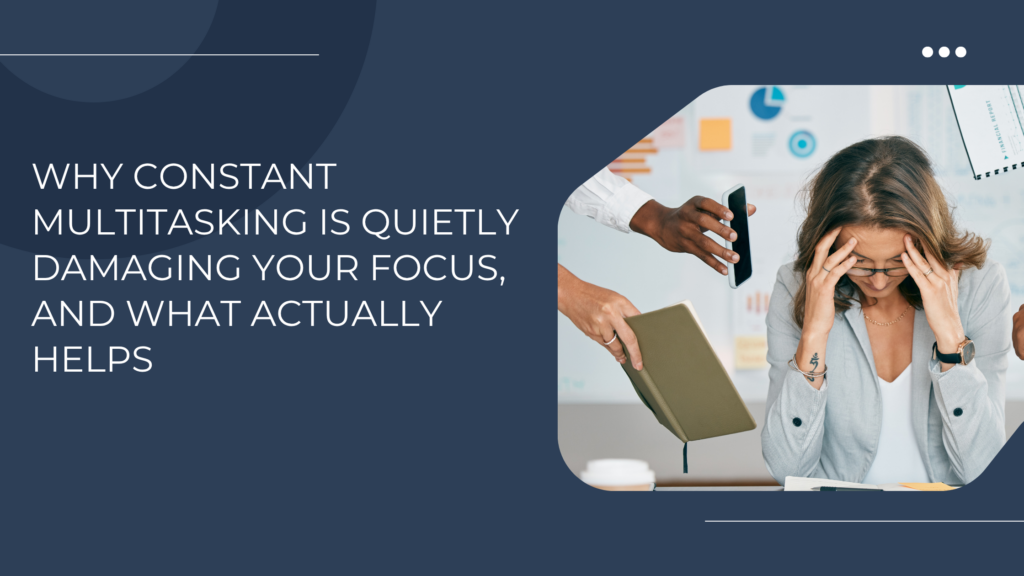
Hustle culture tells us that doing five things at once is a sign of strength. Answering emails during a meeting. Scrolling while watching TV. Planning tomorrow while trying to finish today. It feels productive. It feels necessary. But brain science tells a very different story, and it is not a flattering one.
Your brain was never built to truly do two demanding things at the same time. What feels like multitasking is actually your brain rapidly switching back and forth between tasks, and every single switch comes with a cost. Over time, that cost adds up in ways most people never connect back to the real cause: constant mental fatigue, shrinking attention span, more anxiety, and a nagging feeling that your focus just isn’t what it used to be.
If that sounds familiar, you are not lazy, and you are not broken. You may simply be running a brain that has been overloaded for a long time, and it may be worth understanding what is actually happening before you keep pushing harder.
What Multitasking Actually Does to Your Brain
When you switch between tasks, your brain has to drop what it was focused on, load up the rules for the new task, and then reload the old task again when you go back to it. This constant switching is mentally expensive, even when it feels fast and effortless in the moment.
Each switch causes what researchers call attention residue. Part of your mental focus stays stuck on the previous task even after you’ve moved on to the next one. This means you are rarely giving your full attention to anything, even when you feel busy and engaged all day long.
Over weeks and months of this pattern, many people notice their attention span getting shorter, not longer. Tasks that once felt manageable start to feel overwhelming. Small distractions become harder to ignore. This is not a sign of laziness or lack of willpower. It is a predictable result of constantly asking your brain to juggle more than it can actually hold at once.
The Real Cost: Stress, Anxiety, and Burnout
Multitasking does not just slow you down. It also raises your baseline stress level, often without you noticing it happening. Constantly switching between tasks keeps your nervous system in a low-grade state of alert, because your brain is always managing incomplete tasks in the background.
This is part of why so many high performers describe feeling anxious even when nothing specific is wrong. Their brain is holding open ten unfinished threads at once, and that mental clutter creates a background hum of stress that never fully switches off, even at night.
Left unmanaged, this pattern often leads to burnout. Not the dramatic kind where someone suddenly collapses, but the slow kind, where motivation quietly drains away, work starts to feel heavier than it should, and rest no longer feels restful. By the time most people notice it, the pattern has often been building for months or even years.
Why “Just Focus Better” Doesn’t Work
Telling someone to concentrate harder assumes the problem is effort. In most cases, it isn’t. The brain’s ability to filter distractions, hold attention, and switch tasks smoothly depends on how well its underlying networks are functioning, not on willpower alone.
This is exactly why generic productivity advice, like using a planner or turning off notifications, only goes so far. These tips help around the edges, but they do not address what is actually happening inside a chronically overloaded brain. If the underlying attention system is worn down, no amount of discipline will fully fix it on its own.
This is where a different approach becomes useful, one that looks at how the brain itself is functioning, rather than simply asking a tired brain to try harder.
A Brain-Based Approach to Restoring Focus
Instead of treating constant distraction and mental fatigue as a discipline problem, clinics that specialize in brain health look at what is actually happening in the brain’s attention and stress-regulation networks.
The Brain Performance Center in Dallas, Texas, run by Dr. Leigh Richardson, takes exactly this approach. Rather than offering generic advice, they use tools like Neurofeedback and LENS (Low Energy Neurofeedback System) to help the brain retrain itself toward calmer, more focused patterns.
Neurofeedback works by measuring your brainwave activity and showing your brain, in real time, how it is currently functioning. Over repeated sessions, this feedback helps the brain gradually shift toward more balanced, regulated patterns, the same patterns that support sustained attention and calm decision-making. It does not require you to force concentration during the session. Your brain does the learning on its own, guided by the feedback it receives.
LENS takes a gentler, more passive route. A small sensor placed on the scalp reads brainwave activity, and a very brief, low-energy signal interrupts an overactive pattern found underneath it. Many clients describe feeling noticeably calmer, clearer, and less mentally scattered after just a handful of sessions, without needing to sit and try to relax the way traditional meditation asks of you.
For people who have spent years in high-pressure, multitasking-heavy environments, these tools offer something generic productivity hacks cannot: a way to actually support the brain’s attention system directly, rather than just managing symptoms on the surface.
Everyday Habits That Support a Healthier, More Focused Brain
Alongside any clinical support, a few daily habits make a real difference in how well your brain handles demands without becoming overloaded.
Do one thing at a time, on purpose. Even short stretches of single-tasking, ten or fifteen minutes at a time, help reduce the mental switching cost that builds up throughout the day.
Protect real breaks. Actual rest, without a screen, gives your attention networks time to recover. Scrolling during a break is not the same as resting, since it still demands active attention from your brain.
Get enough sleep. Poor sleep makes every part of this worse, since a tired brain switches tasks even less efficiently and holds onto stress longer.
Move your body daily. Regular physical activity supports the same brain networks responsible for focus and calm decision-making, making it easier to stay on task without constant mental fatigue.
Batch similar tasks together. Answering all your emails in one block, instead of constantly throughout the day, dramatically cuts down on the number of costly mental switches you make.
These habits will not undo years of chronic overload on their own, but combined with the right professional support, they create the conditions your brain actually needs to recover and function well again.
When It’s Time to Get Real Support
If you have tried cutting back on multitasking, protecting your sleep, and building in real breaks, and you still feel mentally foggy, anxious, or constantly overwhelmed, that is often a sign the underlying attention and stress systems in your brain need more direct support than daily habits alone can offer.
This is exactly the kind of pattern that a specialized evaluation can help clarify. Instead of guessing at what’s wrong, a proper assessment looks at how your brain is actually functioning and builds a plan around your specific needs, whether that means Neurofeedback, LENS, Cognitive Behavioral Therapy, or a combination built specifically for you.
Frequently Asked Questions
Is multitasking really bad for the brain, or is this exaggerated?
It is a real, well-documented effect. Your brain does not process two demanding tasks at once. It rapidly switches between them, and each switch carries a real cognitive cost. Over time, this adds up to measurable fatigue, reduced attention span, and increased stress.
Can the effects of years of multitasking be reversed?
In many cases, yes, with consistent changes and the right support. The brain has a genuine ability to adapt and retrain itself over time. This is part of why approaches like Neurofeedback exist, to actively support that process rather than simply waiting for it to happen on its own.
How is Neurofeedback different from just trying to focus harder?
Neurofeedback works with your brain’s own activity in real time, helping it learn to settle into steadier patterns through repeated feedback. It does not rely on willpower or forced concentration the way traditional focus techniques do, which makes it a genuinely different approach rather than just another productivity trick.
Is this approach only for people with ADHD?
No. While many people with ADHD benefit from this kind of brain-based support, chronic multitasking, stress, and attention fatigue affect people without an ADHD diagnosis too. A brain that has been overloaded for years can benefit from this kind of support regardless of diagnosis.
How long does it take to notice a difference?
This varies from person to person, but many people report noticing changes in how calm and focused they feel within the first several sessions. A proper evaluation is the best way to understand a realistic timeline for your specific situation.
How do I know if I need a professional evaluation instead of just changing my habits?
If you’ve genuinely tried reducing multitasking, protecting sleep, and building in real breaks for several weeks and still feel persistently foggy, anxious, or mentally exhausted, that is a reasonable sign to seek a professional evaluation rather than continuing to push through alone.