
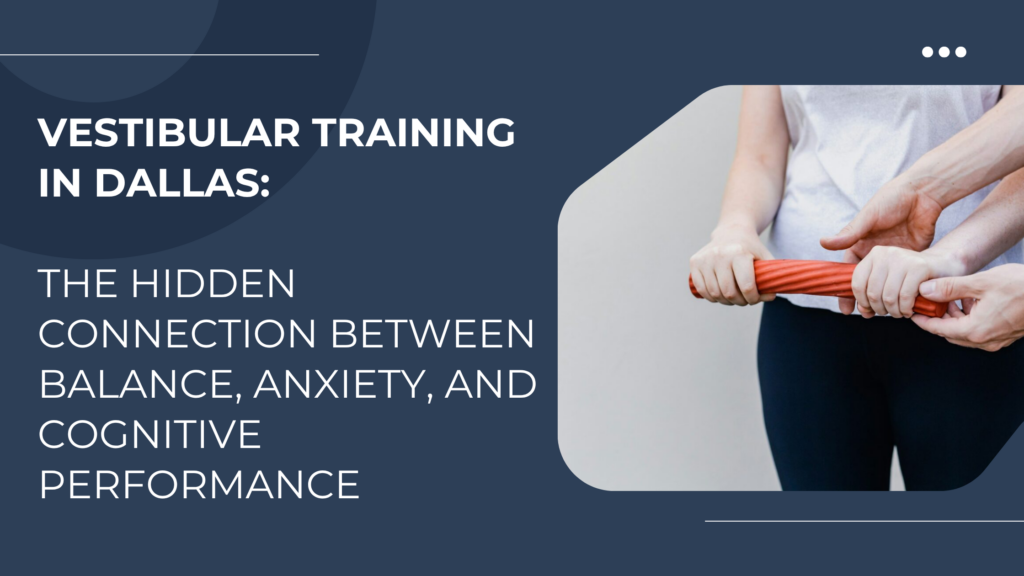
Most people think about balance the way they think about breathing. Something the body just does. Something that only becomes relevant when something goes wrong, when you trip, when a room spins after standing up too fast, when an inner ear infection throws everything sideways for a few miserable days.
What almost nobody thinks about is that the system managing balance in the body is simultaneously doing something far more significant. It is sending a continuous stream of information to the brain that affects how safe or threatened you feel, how clearly you think, how well you can focus, and how efficiently your nervous system regulates itself in response to everything happening around you.
The vestibular system is one of the most underappreciated systems in the human body. And the connection between vestibular function, anxiety, and cognitive performance is one of the most underappreciated connections in brain health, which means that a significant number of people are dealing with anxiety, cognitive fog, focus difficulties, and nervous system dysregulation without anyone having looked at the system that may be significantly contributing to all of it.
At The Brain Performance Center in Dallas, TX, we offer vestibular assessment and training as part of our comprehensive brain health work. This blog is about what the vestibular system actually is, how it connects to anxiety and cognitive performance in ways that most clinicians never mention, what vestibular assessment reveals, and what vestibular training in Dallas TX actually does for people who have been dealing with challenges that other approaches have not fully resolved.
What the Vestibular System Actually Is
The vestibular system is the sensory system responsible for detecting the body’s position and movement in space. It lives primarily in the inner ear, in a fluid-filled structure called the labyrinth that contains the semicircular canals and the otolith organs. These structures detect rotational movement, linear acceleration, and the position of the head relative to gravity.
This information is sent continuously to the brain, where it is integrated with information from the visual system and from the proprioceptive system, which detects position and movement through receptors in muscles, joints, and skin. Together these three systems maintain the brain’s sense of where the body is in space, what it is doing, and whether it is safe and stable.
The vestibular system’s output does not go to a single destination in the brain. It connects to multiple regions simultaneously, and this is where the connection to anxiety, focus, and cognitive performance becomes clear.
Vestibular information goes to the brainstem, which is the control center for the most fundamental regulatory functions including arousal, attention, and autonomic nervous system balance. It goes to the cerebellum, which coordinates movement and timing but is also involved in cognitive processing and emotional regulation. It goes to the thalamus, which acts as the brain’s relay station for sensory information including sensory information that feeds into threat detection. It goes to the cortex, including regions involved in spatial processing, attention, and executive function. And it has connections to the limbic system, the brain’s emotional processing network, which includes the amygdala.
When the vestibular system is functioning well, all of this information arrives accurately and consistently, and the brain uses it to maintain a calm, stable sense of being appropriately grounded in the physical world. When vestibular function is compromised or dysregulated, the inaccurate or inconsistent information arriving from the vestibular system creates a specific kind of neurological confusion that the brain often interprets as threat.
The Connection Between the Vestibular System and Anxiety
This is the connection that most people dealing with anxiety have never heard about, and it is one of the most significant hidden contributors to anxiety that exists.
The brain’s threat-detection system, centered in the amygdala, uses vestibular input as one of its key indicators of physical safety. The logic is ancient and evolutionary. A body that is stable, grounded, and moving predictably through space is a body that is not in immediate physical danger. A body whose position and movement feel uncertain, unstable, or mismatched with what the other senses are reporting is a body that the threat system treats as potentially in danger.
When the vestibular system is not providing clean, accurate information to the brain, the threat system receives conflicting or ambiguous signals about whether the body is safe. The amygdala, which is designed to err on the side of caution, treats ambiguous safety signals as potential threat signals. The result is a nervous system that is running at a higher level of activation than the actual environment warrants.
This is one of the neurological roots of anxiety that medication and standard talk therapy cannot reach, because neither addresses the vestibular system that is feeding the threat response in the first place.
The relationship works in the other direction as well. Anxiety itself affects vestibular processing. The heightened nervous system activation of chronic anxiety affects the brainstem systems that process vestibular information. Some people with anxiety experience dizziness, unsteadiness, or a subtle sense of spatial disorientation that has no structural cause in the vestibular apparatus itself but reflects the dysregulated nervous system that anxiety produces.
This bidirectional relationship means that vestibular dysfunction and anxiety can create and reinforce each other in a cycle that neither standard anxiety treatment nor standard vestibular rehabilitation alone fully addresses. When the vestibular system is assessed and treated as part of an integrated approach to anxiety, the results are often more complete than treating anxiety through other channels alone.
The Specific Anxiety Symptoms Connected to Vestibular Function
Understanding which anxiety symptoms have a vestibular component helps identify who is most likely to benefit from vestibular assessment as part of their treatment.
Anxiety that is accompanied by a persistent sense of unsteadiness or dizziness even without a formal vestibular diagnosis is worth investigating for vestibular contribution. Anxiety that worsens significantly in visually complex environments, crowded spaces, moving environments like cars or stores with fluorescent lighting, or situations involving height or irregular surfaces often has a vestibular component. The visual-vestibular mismatch that these environments create adds load to an already taxed vestibular processing system and amplifies the threat signal the amygdala receives.
Anxiety that has never fully responded to standard approaches, where medication or CBT has helped partially but the underlying nervous system activation remains higher than it should be, sometimes has an unidentified vestibular contribution that was never assessed. Treating the anxiety without addressing the vestibular system that is contributing to it is like treating the symptom without addressing the source.
Panic attacks that include significant physical symptoms, dizziness, a sense of unreality, a feeling of falling or being unmoored in space, often have vestibular involvement. The vestibular-anxiety connection can produce exactly these physical sensations, which then feed the panic spiral by confirming the brain’s threat interpretation of the vestibular signals.
The Connection Between the Vestibular System and Cognitive Performance
The vestibular-cognitive connection is less intuitively obvious than the vestibular-anxiety connection but is equally real and equally important for people dealing with focus difficulties, cognitive fog, and processing challenges.
The vestibular system’s connections to the brainstem’s arousal and attention systems mean that vestibular input directly affects the brain’s arousal level. Appropriate vestibular activation supports appropriate cortical arousal, the level of brain activation that allows for focused, efficient cognitive processing. When vestibular input is dysregulated, arousal regulation is affected, and cognitive performance follows.
Research has consistently found associations between vestibular function and several specific cognitive domains. Spatial processing, the ability to mentally manipulate objects and navigate environments, is directly dependent on accurate vestibular input. Working memory has been found to have unexpected links to vestibular function, with vestibular stimulation shown in research to affect working memory performance. Attention and the ability to filter relevant from irrelevant sensory information is connected to the vestibular system’s role in sensory integration.
For children, the vestibular-cognitive connection is particularly well documented in the learning and development literature. Children with vestibular processing difficulties frequently show challenges with reading, writing, attention, and classroom learning that look identical to the presentation of ADHD but have a different root. Treating the vestibular component in these children often produces improvements in academic performance and attention that ADHD treatments alone did not achieve.
For adults, the vestibular-cognitive connection shows up in the cognitive fog and processing difficulties that accompany conditions where vestibular function is affected, including TBI recovery, post-concussive syndrome, and certain inner ear conditions. But it also shows up in subtler ways in people with no formal vestibular diagnosis whose cognitive performance is being affected by vestibular dysregulation that has never been identified.
Balance, Processing Speed, and Focus
One of the most practically relevant vestibular-cognitive connections is between balance and processing speed. The brain’s ability to maintain postural stability and the brain’s ability to process information quickly share some of the same neural resources, particularly in the cerebellum.
The cerebellum has traditionally been understood as a motor coordination structure. Research over the last two decades has substantially revised this view. The cerebellum is involved in the timing and sequencing of cognitive processes as well as motor processes. It contributes to the speed and fluency with which cognitive operations are carried out. When cerebellar function is affected by vestibular dysregulation, cognitive timing and processing speed are affected alongside motor coordination.
This is why people with significant vestibular dysfunction often describe their cognitive experience in temporal terms. Thinking that feels slow. Processing that has an unusual lag. The sense that information is arriving correctly but being handled at a speed that does not match the demand.
Vestibular training in Dallas TX at The Brain Performance Center addresses this through targeted exercises that stimulate and strengthen the vestibular pathways connected to cerebellar function, producing improvements in processing efficiency that contribute to cognitive performance improvements alongside the balance and anxiety benefits.
What Vestibular Assessment Reveals
At The Brain Performance Center, vestibular assessment is a systematic evaluation of how the vestibular system is functioning and how it is integrating with the visual and proprioceptive systems.
The assessment looks at several dimensions that give us a complete picture of vestibular function and dysfunction.
Oculomotor function is examined because the vestibular system’s connections to the eye movement system, through the vestibulo-ocular reflex, are some of the most direct and measurable expressions of vestibular processing. How the eyes track moving objects, how they stabilize the visual field during head movement, and how they respond to specific vestibular stimulation reveals the efficiency of the vestibular-visual connection.
Balance and postural stability under different sensory conditions tells us how the brain is integrating vestibular, visual, and proprioceptive information. When balance is maintained under conditions that remove or conflict one of these inputs, we can identify which system or integration pathway is contributing to difficulty.
Sensitivity to visual motion and visual complexity reveals how the brain is weighting visual versus vestibular information. Some people with vestibular dysfunction become over-reliant on visual information for orientation, which creates significant difficulty in visually complex or moving environments.
The connection between vestibular findings and the client’s reported symptoms, their anxiety patterns, their cognitive difficulties, their specific challenging environments, is one of the most clinically valuable parts of the assessment because it makes the mechanism of the problem visible rather than leaving it as an unexplained cluster of symptoms.
The assessment findings shape the vestibular training plan. Different vestibular profiles require different training approaches, and beginning training without assessment is beginning without the map of what needs to be trained.
What Vestibular Training at The Brain Performance Center Involves
Vestibular training in Dallas TX at The Brain Performance Center is targeted, progressive, and integrated with the other brain training tools we use. It is not a generic balance exercise program. It is a clinical training protocol built around what the assessment revealed about how the vestibular system is functioning and how it is connecting to the anxiety and cognitive performance challenges the client is dealing with.
Gaze Stabilization Training
Gaze stabilization training works with the vestibulo-ocular reflex to improve the efficiency with which the eyes stabilize the visual field during head movement. When this reflex is functioning poorly, the visual world appears to move or blur during head movement, creating both a physical disorientation and a sensory mismatch that the threat system interprets as instability.
Progressive gaze stabilization exercises train the vestibulo-ocular reflex to respond more accurately and efficiently. As the reflex improves, the visual world stabilizes during movement, the sensory mismatch decreases, and the nervous system receives cleaner, more consistent signals about physical safety.
Visual-Vestibular Integration Training
Visual-vestibular integration training addresses the way the brain combines vestibular and visual information. For clients who are over-relying on visual input because vestibular signals are unreliable, exercises that progressively challenge the visual system while training the vestibular system to provide more accurate information re-establish the appropriate balance between these two sources.
This training is particularly relevant for anxiety connected to visually complex or moving environments. As the vestibular system’s contribution to orientation becomes more reliable, the over-reliance on visual input decreases, and the specific anxiety triggered by visual complexity reduces alongside it.
Proprioceptive-Vestibular Integration
Proprioceptive-vestibular integration training works with the way vestibular and body-position information combine to maintain postural stability and spatial orientation. Exercises that progressively vary the surface, the position, and the movement demands train the integration of these two systems, improving the overall stability of the orientation system and reducing the sensory ambiguity that feeds threat system activation.
How Vestibular Training Integrates with Neurofeedback and Other Brain Training
At The Brain Performance Center, vestibular training does not happen in isolation from the other brain training tools we use. The integration is deliberate and produces results that are more complete than any single tool alone.
Neurofeedback addresses the brain’s electrical patterns that anxiety, ADHD, and cognitive difficulties are producing. Vestibular training addresses the sensory processing input that is contributing to those patterns. When both are happening simultaneously, the vestibular system is providing cleaner input to the brain at the same time that the brain is being trained toward more regulated patterns in response to that input. The two reinforce each other.
LENS therapy, which calms the nervous system’s baseline activation level, creates better conditions for vestibular training by reducing the threat system’s hypersensitivity that is amplifying the effect of vestibular signals. A nervous system that is less hyperactivated is better able to process and adapt to the vestibular training exercises without triggering a threat response that interferes with the training.
CBT addresses the cognitive patterns that have developed around vestibular-related anxiety. When specific environments or situations have become associated with anxiety because of vestibular-driven threat signals, CBT provides the framework for distinguishing between the signal and the actual threat, and for gradually rebuilding engagement with situations that avoidance has been maintaining as feared.
| Vestibular Training Component | What It Targets | Connection to Anxiety and Cognition |
| Gaze stabilization | Vestibulo-ocular reflex efficiency | Reduces sensory mismatch that feeds threat activation |
| Visual-vestibular integration | Balance of visual and vestibular input | Decreases visually complex environment anxiety |
| Proprioceptive-vestibular integration | Multi-system orientation accuracy | Improves postural stability, reduces ambient threat signals |
| Progressive movement challenges | Vestibular system adaptation and recalibration | Builds tolerance to movement-related sensory input |
| Cognitive-vestibular dual tasks | Vestibular and cognitive processing simultaneously | Improves cognitive performance under vestibular demand |
Who Benefits Most from Vestibular Assessment and Training
Not everyone who comes to The Brain Performance Center needs vestibular assessment. But a specific profile of people benefit significantly and often unexpectedly from having this system assessed and trained.
People with anxiety that has never fully resolved through standard treatment, particularly anxiety accompanied by physical sensations of unsteadiness, dizziness, or a sense of being not quite grounded in the physical world. The vestibular contribution to the anxiety is often the piece that was never identified or addressed.
People dealing with cognitive fog and processing difficulties that do not fully explain through the obvious candidates of sleep, stress, or mood. When working memory, processing speed, and cognitive efficiency are affected and the standard explanations do not fully account for the picture, vestibular function is worth examining.
Children with attention and learning difficulties that look like ADHD but have not responded as expected to ADHD treatment. The vestibular-cognitive connection in children is particularly significant, and vestibular assessment sometimes reveals a primary driver of the learning difficulties that was not being addressed.
People recovering from TBI or concussion, where vestibular disruption is almost universally present and is one of the most significant contributors to the ongoing cognitive and emotional symptoms of post-concussive syndrome. Vestibular rehabilitation is central to TBI recovery, and at The Brain Performance Center it is integrated with neurofeedback and other brain training tools for a comprehensive recovery approach.
People who are anxious specifically in visually complex environments, crowded spaces, moving situations, or situations involving height or spatial challenge. These are the environmental signatures of visual-vestibular mismatch, and vestibular assessment typically reveals the specific processing pattern producing the environmental specificity of the anxiety.
People whose anxiety or cognitive difficulties worsened after a physical illness, ear infection, head impact, or period of significant physical stress. Vestibular disruption can follow physical events and produce anxiety and cognitive changes that look like a psychological response to the event but are partly a neurological consequence of vestibular disruption.
What People Notice After Vestibular Training
The changes that follow vestibular training at The Brain Performance Center are often surprising to clients who did not realize how much vestibular function was contributing to their symptoms.
The first things people typically notice are the physical ones. A sense of being more grounded and stable in their body. Reduced dizziness or unsteadiness in situations that previously produced it. Environments that were previously disorienting or anxiety-producing becoming more manageable. The visual world feeling more stable during movement.
Then the anxiety changes become noticeable. The background sense of unease that was present in specific environments or situations decreases. The nervous system feels less easily activated. The recovery from stressful situations is faster because the ambient threat signal from the vestibular system has reduced.
Then the cognitive changes. Mental clarity that is more consistent. Processing that feels less effortful. The ability to think in complex or stimulating environments without the cognitive degradation that previously happened in those settings. Working memory that holds more reliably. Focus that is less disrupted by the sensory environment.
These changes are not what most people expected when they came in for anxiety or cognitive performance treatment. They did not expect that a system they had never thought about was contributing to difficulties they had been managing for years. But the consistency with which vestibular assessment reveals a contributing factor in people with the right profile, and the consistency with which vestibular training produces meaningful improvements alongside the other brain training tools, makes it one of the most important components of comprehensive brain health work at The Brain Performance Center.
Frequently Asked Questions About Vestibular Training in Dallas
How do I know if my anxiety or cognitive difficulties have a vestibular component?
The most reliable way to know is through vestibular assessment. Certain patterns suggest vestibular contribution worth investigating: anxiety that worsens significantly in visually complex or moving environments, dizziness or unsteadiness accompanying anxiety, cognitive fog that is worse in stimulating environments, a history of concussion or significant inner ear illness, and anxiety or cognitive difficulties that have not fully responded to standard treatment. If several of these apply, vestibular assessment is worth discussing during your consultation.
Does vestibular training involve anything uncomfortable or disorienting?
Vestibular training is progressive and carefully calibrated to stay within tolerable limits. Because the vestibular system is involved in the threat response, exercises that are too challenging too quickly can trigger the exact responses they are trying to treat. We build vestibular training progressively, starting well within the comfortable range and advancing based on response. The training is challenging in a productive way rather than distressing.
How does vestibular training fit into a broader treatment plan at The Brain Performance Center?
Vestibular training is integrated with the other brain training tools rather than delivered in isolation. The timing, sequencing, and combination of vestibular training with neurofeedback, LENS, CBT, and executive function training is determined by the individual client’s brain map findings, vestibular assessment results, and the specific challenges they are dealing with. The integration is one of the things that makes the approach at The Brain Performance Center different from receiving vestibular rehabilitation and mental health treatment in separate, uncoordinated settings.
Is vestibular training relevant for children with learning difficulties?
Yes, and particularly for children whose learning and attention difficulties have not fully responded to standard ADHD or learning support approaches. The vestibular-cognitive connection in children is well established in the developmental research, and vestibular assessment sometimes reveals a significant contributing factor to learning difficulties that was not previously identified. Vestibular training for children is adapted to be engaging and age-appropriate, and the integration with neurofeedback and other brain training tools produces comprehensive support for the full picture of the child’s challenges.
How many sessions of vestibular training are typically needed?
This depends on the severity of the vestibular dysfunction identified in assessment, how long it has been present, and how significantly it is contributing to the overall picture. Vestibular training is typically delivered over weeks to months, with frequency determined by the assessment findings and the client’s response to training. We track progress throughout and adjust based on what the assessment data and the client’s experience are showing.
The System Nobody Told You About
There is a reason vestibular assessment is not part of standard mental health or cognitive performance treatment. The mental health field focuses on the brain and mind. The vestibular field focuses on balance and the inner ear. The connection between them falls into the gap between specialties, and the people most affected by that gap are the ones dealing with anxiety and cognitive difficulties that have a vestibular component nobody ever looked for.
At The Brain Performance Center in Dallas, TX, we look at the whole system. The brain map tells us what the electrical patterns are doing. The vestibular assessment tells us what the sensory input feeding the brain is doing. The integration of these two pictures, and the treatment built around both, produces results that neither piece alone could achieve.
If you have been dealing with anxiety, cognitive fog, focus difficulties, or nervous system dysregulation and standard approaches have not produced the complete resolution you were hoping for, the vestibular system is worth understanding and assessing. It may be the piece of the picture that nobody has looked at yet.
Vestibular training in Dallas TX at The Brain Performance Center is available as part of a comprehensive assessment and treatment approach. We are at 8215 Westchester Drive, Suite 243, Dallas, TX 75225. Our hours are Monday through Thursday 10 AM to 6 PM and Friday and Saturday 10 AM to 5 PM. Call us at 214-329-9017 or fill out the contact form on our website to set up your free consultation.
The system nobody told you about may be the one that changes everything.