
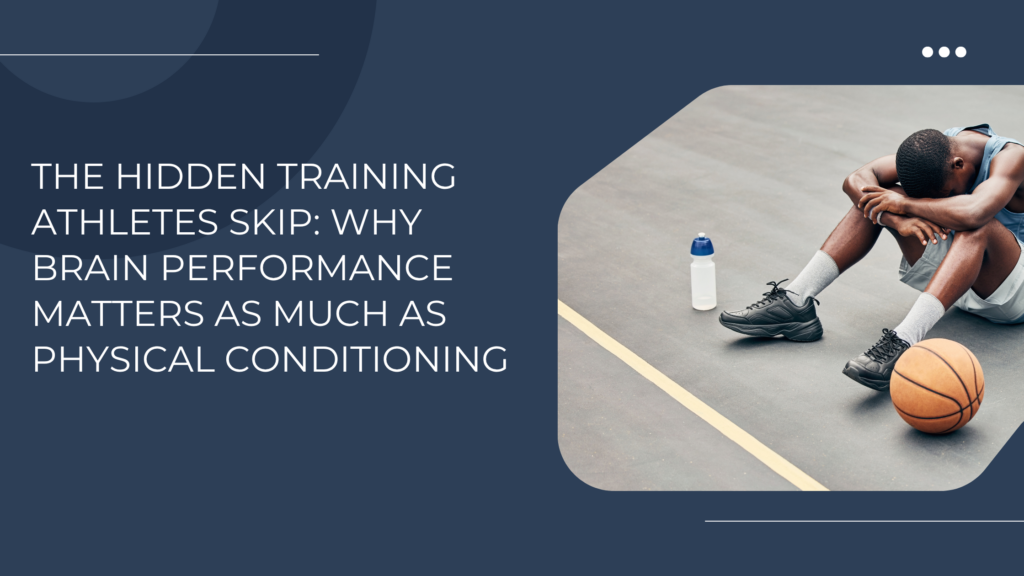
Athletes spend years perfecting their bodies. Strength training, speed drills, nutrition plans, recovery protocols, all carefully mapped out and tracked. But there’s one part of athletic performance that rarely gets the same structured attention, even though it directly affects every single one of those physical skills: the brain.
Reaction time, focus under pressure, decision-making in split seconds, emotional control after a mistake, all of this runs through the brain first, before it ever shows up in the body. And yet most athletes train their muscles far more deliberately than they train the organ actually controlling those muscles.
Your Brain Is Running the Show, Even When You’re Not Thinking About It
Every physical skill an athlete relies on starts as a brain function first. Reaction speed isn’t just about fast muscles, it’s about how quickly your brain processes information and sends the signal to move. Precision under pressure isn’t only about repetition, it’s about how well your brain manages stress hormones without letting them hijack your focus.
This is why two athletes with nearly identical physical conditioning can perform completely differently in a high-pressure moment. The difference often isn’t in their legs, their lungs, or their muscles. It’s in how their brain handles pressure, processes information, and recovers from a mistake mid-competition.
Why Mental Toughness Isn’t Just a Mindset, It’s a Brain Function
Athletes are often told to “be mentally tough” or “stay focused,” as if these are simply choices you make through willpower alone. In reality, focus, composure under pressure, and quick recovery from a bad play are functions of how well-regulated the brain’s stress and attention systems actually are.
An athlete whose nervous system is chronically overactivated, from overtraining, poor sleep, competition stress, or unresolved anxiety, isn’t working with the same brain as one whose system is well-regulated, even if their physical training is identical. This is why some athletes seem to “choke” under pressure while others perform their best exactly when it matters most. It’s rarely about desire or effort. It’s about brain regulation.
The Cost of Ignoring Brain Training in Athletic Development
Skipping brain-specific training doesn’t mean an athlete’s mental performance stays neutral. It usually means it becomes the limiting factor nobody identified. An athlete can spend years building elite physical conditioning and still underperform consistently in competition because their focus breaks down under pressure, their reaction time slows when stakes are high, or they struggle to reset emotionally after a mistake.
This is often mistaken for a confidence problem or a mental game the athlete simply “doesn’t have,” when it’s actually an untrained, unsupported brain function, the same way a weak hamstring would be treated as a physical training gap, not a character flaw.
Sleep: The Most Underrated Performance Tool in Sports
Athletes obsess over recovery, ice baths, compression gear, massage, stretching, but sleep is often the most under-prioritized recovery tool of all, despite being where the brain does its most important repair and consolidation work.
Poor sleep directly affects reaction time, decision-making speed, and emotional regulation, three things that separate a good performance from a great one. An athlete who trains hard but consistently shortchanges sleep is often working against their own performance without realizing where the real limitation is coming from.
Stress Recovery: The Skill Most Athletes Never Actually Train
Physical training includes built-in recovery, rest days, tapering, deload weeks. Mental and emotional recovery rarely gets the same intentional structure, even though competitive stress accumulates in the brain just as fatigue accumulates in muscles.
An athlete who never trains their brain’s ability to recover from stress often carries tension from one competition into the next, or from one bad play into the rest of the game. Learning to reset quickly, mentally and physiologically, after a stressful moment is a trainable skill, not a fixed personality trait.
A More Direct Way to Train the Brain for Performance
This is exactly the gap addressed at The Brain Performance Center in Dallas, Texas, led by Dr. Leigh Richardson. Rather than treating mental performance as something abstract athletes are simply told to “work on,” the center uses tools like Neurofeedback and LENS (Low Energy Neurofeedback System) to train the brain’s regulation systems directly, the same systems responsible for focus, composure under pressure, and fast recovery from stress.
Neurofeedback works by measuring an athlete’s brainwave activity and feeding that information back in real time. Over repeated sessions, the brain learns to settle into steadier, more efficient patterns, supporting sharper focus, quicker reaction time, and better composure in high-pressure moments. This isn’t about relaxation for its own sake. It’s about training the brain’s regulation systems the same deliberate way an athlete trains muscle groups.
LENS offers a more passive approach to the same goal. A small sensor placed on the scalp reads brainwave activity, and a brief, low-energy signal interrupts an overactive pattern. Athletes often notice improved mental clarity, calmer competition nerves, and better sleep after just a handful of sessions, all supporting the same performance systems from a different angle.
For athletes who have already maximized their physical training and still feel like something is holding back their performance under pressure, this kind of direct brain training often addresses exactly the gap that physical conditioning alone cannot reach.
Everyday Habits That Support Athletic Brain Performance
Alongside structured training, a few daily habits support the brain systems athletes depend on most.
Protect sleep like it’s part of training, because it is. Reaction time, decision-making, and emotional control all depend heavily on consistent, quality sleep.
Build in real mental recovery, not just physical recovery. A few minutes of deliberate calm after a stressful training session or competition helps the brain reset, the same way stretching helps muscles reset.
Practice performing under simulated pressure. Training the brain to stay steady under stress works best when it’s practiced in advance, not left to chance on competition day.
Fuel and hydrate for brain function, not just muscle function. The brain is highly sensitive to dehydration and poor nutrition, both of which show up quickly as slower reaction time and weaker focus.
Pay attention to composure, not just stats. Notice how quickly you reset after a mistake or a bad play. This recovery speed is a trainable skill, not a fixed trait.
Why This Matters for Athletes at Every Level
Whether you’re competing at a high school, collegiate, or professional level, the brain is doing just as much work as the body during competition, often more, in the moments that matter most. Ignoring this side of training doesn’t mean it stops affecting performance. It just means it stays untrained, unsupported, and often misunderstood as a personality issue rather than a trainable brain function.
Athletes who treat brain performance with the same intentional structure as physical training often find the missing piece that physical conditioning alone was never going to solve.
Frequently Asked Questions
Is brain training really necessary if an athlete is already physically elite?
Yes, often especially then. At elite levels, physical differences between competitors shrink, and mental performance, focus, composure, and recovery from stress, frequently becomes the real deciding factor.
Can brain training actually improve reaction time?
Reaction time depends heavily on how efficiently the brain processes information and signals the body to respond. Training that supports better brain regulation, like Neurofeedback, can support improvements in this area.
Is “choking under pressure” really a brain regulation issue?
Often, yes. Performing worse specifically under high-pressure conditions is frequently linked to an overactivated stress response rather than a lack of skill or effort, and this is a trainable pattern.
How is this different from standard sports psychology?
Sports psychology typically works with mindset, strategy, and mental coaching. Brain-based training like Neurofeedback works directly with the brain’s underlying regulation patterns, targeting the physiological systems behind focus and composure, rather than only the thoughts and strategies layered on top.
How much does sleep really affect athletic performance?
Significantly. Sleep directly affects reaction time, decision-making speed, and emotional regulation, three factors that often separate a good performance from a great one at any level of competition.
Can younger or developing athletes benefit from this kind of brain training too?
Yes. Since focus, stress regulation, and composure under pressure are trainable skills, building these systems early can support both athletic performance and overall development.
How would an athlete know if brain training could help them specifically?
If physical training has plateaued despite consistent effort, or if performance regularly drops under pressure despite strong practice results, that’s often a sign the brain’s regulation systems, not physical conditioning, are the real limiting factor worth evaluating.