
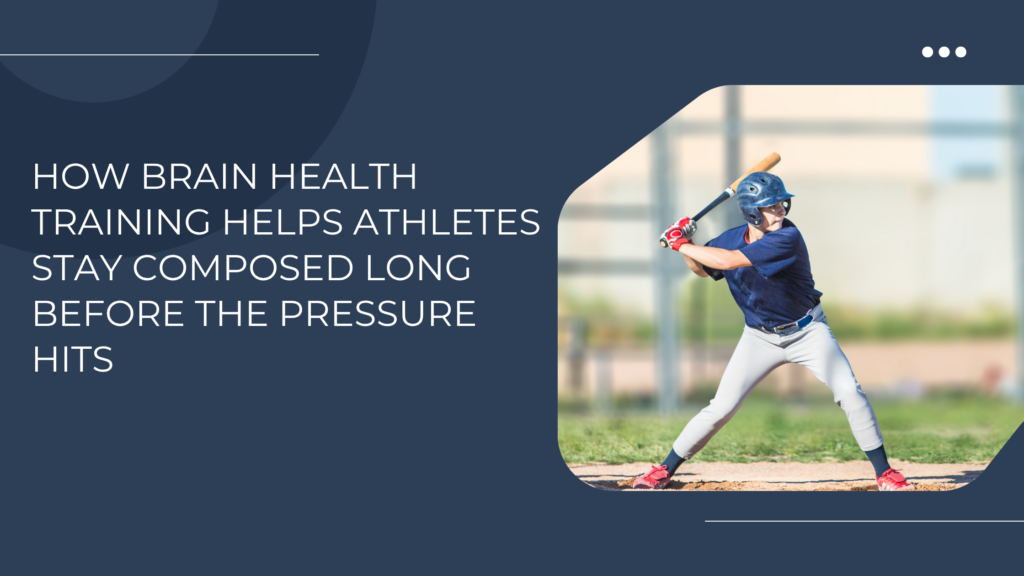
Watch any elite athlete perform under intense pressure, a final shot, a last lap, a championship point, and it can look almost effortless. It isn’t. What looks like natural composure in that single moment is actually the result of something built months and years earlier, through practice, reflection, discipline, and repeatedly learning how to respond when things don’t go according to plan.
Elite performance isn’t created in the pressure moment itself. It’s revealed there. The real training happens long before the pressure ever arrives, and it happens inside the brain just as much as it happens in the body.
Pressure Doesn’t Build Skill, It Reveals It
A common myth in sports is that pressure itself makes athletes better, that competing in high-stakes moments is what forges composure. In reality, pressure mostly reveals whatever has already been built. It doesn’t create calm under fire. It exposes whether calm under fire was ever actually trained in the first place.
This is why two equally talented athletes can respond so differently in the exact same high-pressure situation. One has spent months building the mental and physiological patterns needed to stay composed. The other hasn’t, regardless of how talented or physically prepared they are. The pressure moment simply shows the difference, and that difference lives in how well-trained their brain health actually is.
Practice: Training the Response, Not Just the Skill
Most athletes understand practice as repetition of physical skill, running the same play, the same shot, the same routine until it becomes automatic. But elite performance requires a second, less obvious layer of practice: training how you respond when that skill doesn’t go as planned.
An athlete who only ever practices success is unprepared for the moment things go wrong in competition, because that specific mental and physiological response was never actually trained. Practicing recovery, how you reset after a missed shot, a bad call, or an unexpected setback, deserves the same deliberate repetition as the physical skill itself. This is brain health training in its most practical form.
Reflection: The Step Most Athletes Skip
After a tough loss or a mistake, many athletes either replay it obsessively or push it away entirely, trying not to think about it at all. Neither approach actually builds anything. Genuine reflection, calmly reviewing what happened, what your brain and body did in that moment, and what you’d do differently, is what turns a setback into usable information instead of just an unpleasant memory.
This kind of reflection is uncomfortable, which is exactly why so many athletes skip it. But it’s also where real adjustment happens. Skipping it doesn’t make the setback disappear. It just means the same pattern is more likely to repeat itself next time the pressure returns.
Discipline: Showing Up When Nothing Is on the Line
Elite composure under pressure isn’t built during the pressure moments themselves, there simply aren’t enough of them. It’s built through consistent, disciplined work during the ordinary, low-stakes days that make up the vast majority of an athlete’s training life.
This is why discipline in quiet, unglamorous moments, an early training session, a recovery routine nobody’s watching, a mental reset practiced when nothing is actually at stake, matters so much. These moments are where the actual pattern gets built. The championship moment is simply where it gets tested.
Learning to Respond, Not Just React
There’s an important difference between reacting and responding. Reacting is automatic and often driven by whatever the nervous system defaults to under stress. Responding is trained, a deliberate pattern built through repetition, so that even under real pressure, the athlete has something more useful than a raw, unfiltered reaction to fall back on.
This distinction is exactly what separates athletes who fall apart after a bad start from those who steady themselves and keep competing. It isn’t a personality trait some athletes simply have. It’s a trained response, built through the same deliberate, repeated process as any physical skill, and it depends heavily on the health and regulation of the brain behind it.
Why This Is a Brain Health Issue, Not Just a Mindset Issue
Practice, reflection, discipline, and learning to respond under pressure all rely on how well an athlete’s brain regulates stress, attention, and recovery. These aren’t abstract character traits. They’re functions of a trainable nervous system, which means brain health, not just physical conditioning or mindset coaching, plays a direct role in whether an athlete can actually access their training when it matters most.
An athlete whose brain health is well-supported, through good sleep, stress regulation, and a nervous system that resets efficiently after setbacks, has a real physiological advantage in high-pressure moments. An athlete whose brain health has been neglected is working against themselves, regardless of how much physical training they’ve put in.
What Strong Brain Health Actually Looks Like for an Athlete
Good brain health in an athletic context isn’t a vague wellness concept. It shows up in specific, measurable ways.
Faster mental recovery after a mistake. An athlete with strong brain health resets quickly after a bad play instead of carrying it into the next one.
Steadier focus under fatigue. As physical tiredness increases late in competition, brain health determines whether focus holds steady or starts to break down.
Better decision-making under time pressure. Split-second decisions rely on a brain that isn’t already overloaded with unmanaged stress.
More consistent performance across high and low-stakes situations. An athlete with strong brain health doesn’t need the pressure of a big moment to perform well. Their baseline regulation carries over.
Everyday Habits That Build Athletic Brain Health
A few consistent habits support the brain health elite performance depends on.
Protect sleep like it’s part of training, because it is. Reaction time, decision-making, and emotional control all depend heavily on consistent, quality sleep.
Build in real mental recovery, not just physical recovery. A few minutes of deliberate calm after a stressful training session or competition helps the brain reset, the same way stretching helps muscles reset.
Practice reflection on purpose, not just after big losses. Regularly reviewing smaller setbacks builds the habit before it’s ever needed in a high-stakes moment.
Practice performing under simulated pressure. Training the brain to stay steady under stress works best when it’s rehearsed in advance, not left to chance on competition day.
Fuel and hydrate for brain function, not just muscle function. The brain is highly sensitive to dehydration and poor nutrition, both of which show up quickly as slower reaction time and weaker focus.
Why This Matters for Athletes at Every Level
Whether competing at a high school, collegiate, or professional level, the brain is doing just as much work as the body during competition, often more, in the moments that matter most. Athletes who treat brain health with the same intentional structure as physical training often find the missing piece that physical conditioning alone was never going to solve.
Composure under pressure isn’t luck, talent alone, or a fixed personality trait. It’s the visible result of brain health that was quietly built long before the pressure ever arrived.
Frequently Asked Questions
Is brain health training really necessary if an athlete is already physically elite?
Yes, often especially then. At elite levels, physical differences between competitors shrink, and brain health, focus, composure, and recovery from stress, frequently becomes the real deciding factor.
Can brain health training actually improve reaction time?
Reaction time depends heavily on how efficiently the brain processes information and signals the body to respond. Supporting overall brain health can meaningfully support improvements in this area.
Is “choking under pressure” really a brain health issue?
Often, yes. Performing worse specifically under high-pressure conditions is frequently linked to an overactivated stress response rather than a lack of skill or effort, and this is closely tied to how well-regulated an athlete’s brain health actually is.
How is this different from standard sports psychology?
Sports psychology typically works with mindset, strategy, and mental coaching. Brain health focuses on the underlying physiological regulation, sleep, stress recovery, and nervous system balance, that determines whether that mindset training can actually be accessed under real pressure.
How much does sleep really affect athletic performance?
Significantly. Sleep is one of the most important pillars of brain health, directly affecting reaction time, decision-making speed, and emotional regulation, three factors that often separate a good performance from a great one.
Can younger or developing athletes benefit from focusing on brain health early?
Yes. Since focus, stress regulation, and composure under pressure are trainable, building strong brain health habits early can support both athletic performance and long-term development.
How would an athlete know if their brain health needs more attention?
If physical training has plateaued despite consistent effort, or if performance regularly drops under pressure despite strong practice results, that’s often a sign brain health, not physical conditioning, is the real limiting factor worth addressing.